
Across the United States, aging dams and reservoirs are presenting water managers and municipal agencies with a mounting challenge. Many of these structures were built decades ago and are now reaching or exceeding their intended design life. Beneath the surface, hidden within these vital systems, lie steel outlet pipes that have quietly corroded, worn, or deteriorated over time. For cities and water authorities tasked with maintaining safe, reliable infrastructure, these issues pose a dilemma: how do you rehabilitate critical dam components without draining entire lakes or disrupting the communities that rely on them?
Traditionally, the answer has been both straightforward and disruptive — drain the lake, repair or replace the outlet, and then slowly refill the reservoir. But as municipalities face tighter budgets, stricter environmental regulations, and growing public scrutiny, this approach is becoming increasingly difficult to justify.
Fortunately, trenchless technologies are redefining what’s possible in dam rehabilitation, offering ways to restore critical infrastructure from within safely, efficiently, and with minimal environmental impact.
The Traditional Approach: Necessary but Costly
For decades, repairing or replacing a dam’s outlet system required a full drawdown of the reservoir. Once the water level was low enough, crews could access the outlet pipe, remove the damaged sections, and install new components.
While this approach works technically, it creates a cascade of complications. Draining a lake can devastate aquatic ecosystems, fish and wildlife are displaced, vegetation dies off, water quality suffers for years, and recreation halts. Local economies dependent on fishing, boating, and tourism take a hit. Power generation or irrigation operations are interrupted, and refilling the reservoir can take multiple seasons, depending on the climate and inflow rates.
From a municipal perspective, these impacts aren’t just environmental; they’re financial and political. Residents notice when a lake disappears, and they expect answers. For public works directors, engineers, and infrastructure managers, the question becomes: Is there a better way to restore dam infrastructure without sacrificing community and environmental stability?
A Trenchless Alternative: Working from Within
Enter trenchless rehabilitation, an engineering approach that renews existing infrastructure from the inside out. Instead of excavation or draining, a new protective liner is installed inside the existing pipeline, creating a long-lasting, corrosion-resistant barrier without the need for replacement.
United Pipeline Systems, a global leader in pipeline integrity solutions, has pioneered this technology for more than 30 years through its Tite Liner® system. Designed specifically for pressure pipelines, the Tite Liner process uses high-density thermoplastic liners that are thermally fused into continuous lengths and pulled through existing host pipes. Once installed, the liner expands tightly against the host wall, forming a durable, leak-free fit that resists corrosion, abrasion, and chemical attack.
In municipal environments, this approach has proven especially valuable. Many cities face aging water transmission and sewer systems, and traditional “dig-and-replace” methods are not only expensive but disruptive to roads, neighborhoods, and waterways. The Tite Liner system allows municipalities to extend the life of pressure pipelines, raw water lines, and dam outlets without tearing up infrastructure or draining vital reservoirs.
Case in Point: Dam Outlet Rehabilitation in Pueblo, Colorado
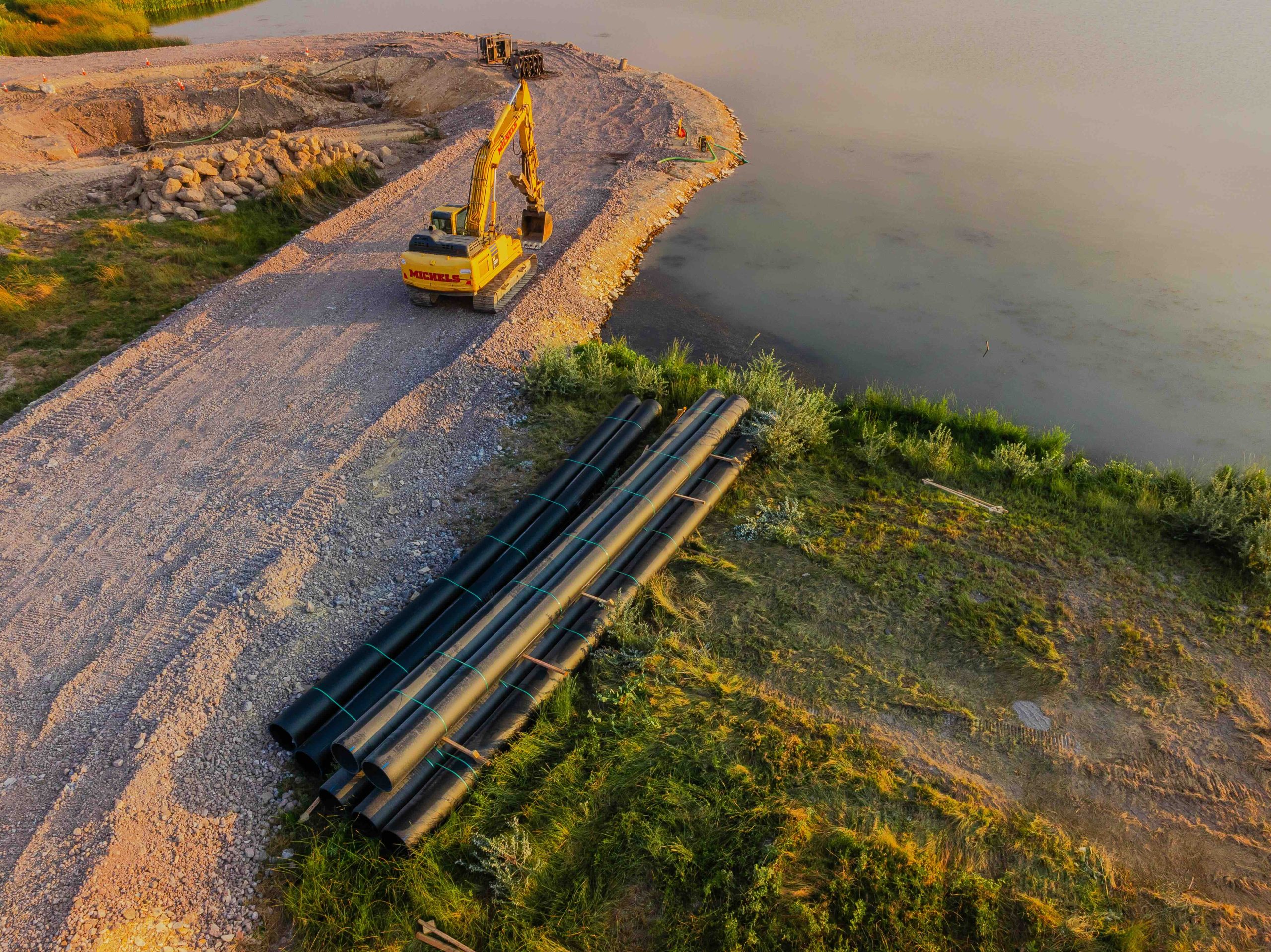
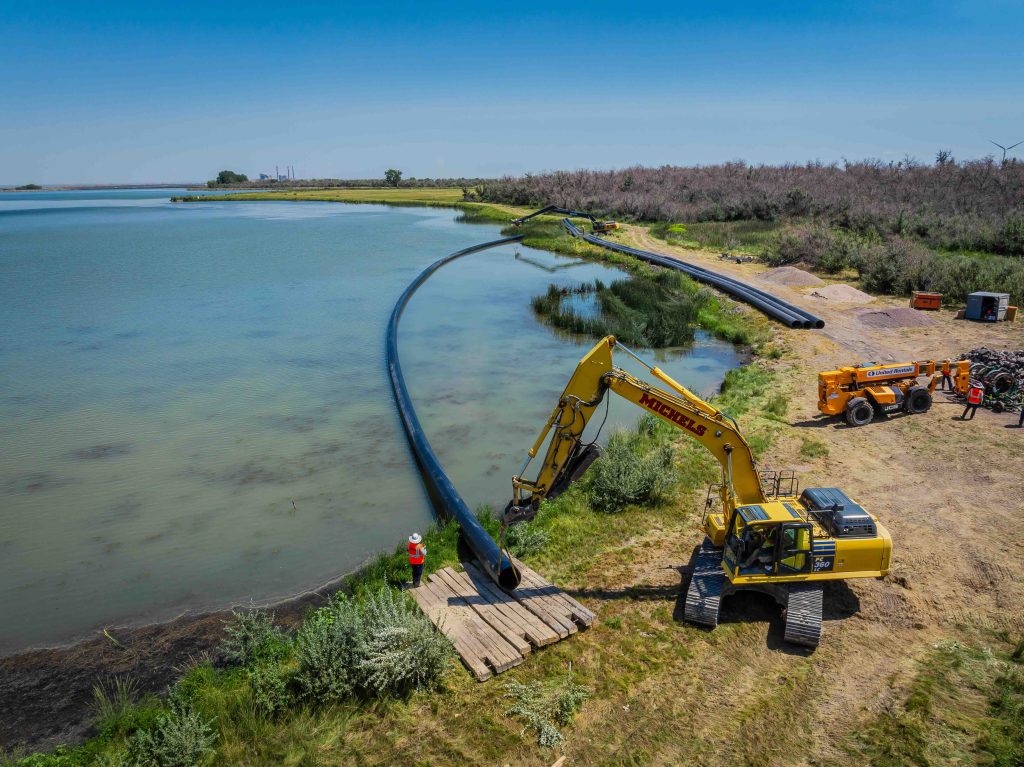
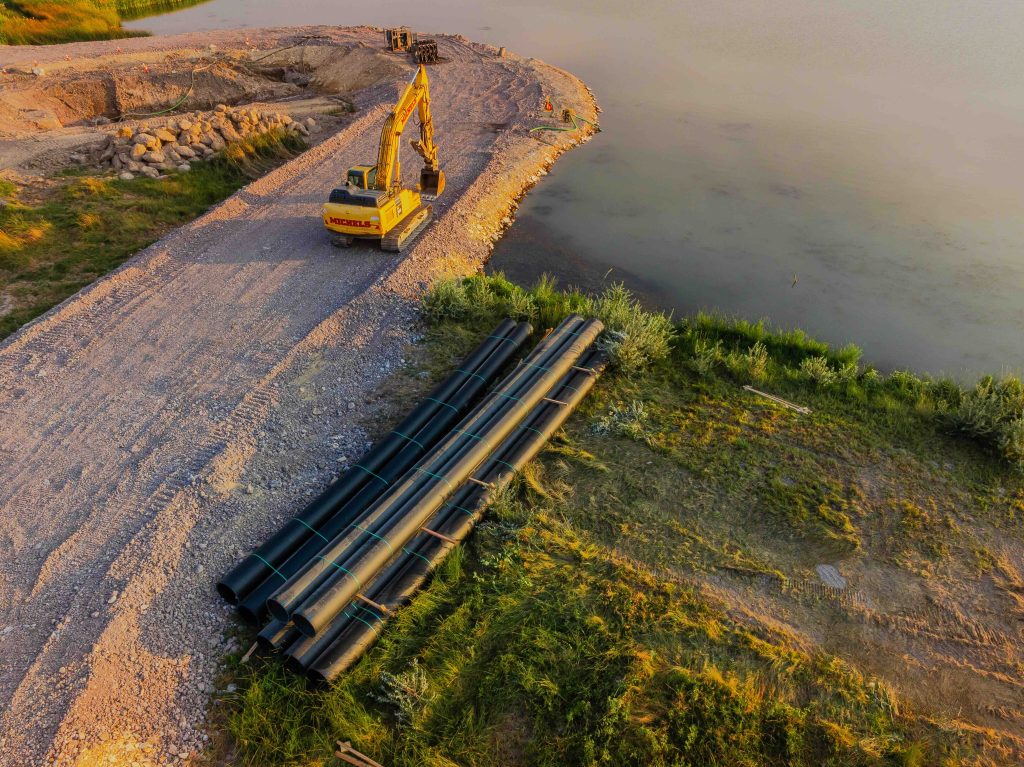
A recent industrial water supply project in Pueblo, Colorado, showcases how trenchless technology is reshaping dam rehabilitation. The outlet system, which supplies water from the upper reservoir to the lower reservoir for industrial purposes had begun to deteriorate, threatening long-term performance and water delivery reliability. Traditionally, this type of repair would have required excavation of the dam between the two reservoirs, along with draining both reservoirs — an approach that would have caused years of ecological and operational disruption.
Instead, United Pipeline Systems restored the outlet by draining just one reservoir and keeping the earthen dam in place, using its proven Tite Liner® HDPE lining system.
Key Installation Highlights
- Liners were maneuvered across the lake surface and sealed with airtight plugs before installation.
- Using a roller reduction box, each liner was temporarily compressed for insertion, then released to expand tightly against the existing steel pipe for a secure compression fit.
- The butt fusion process was used to join liner segments — each end shaved flush, heated with a hot plate, and fused to create a single continuous length.
- The first joint was cut out and tested to confirm integrity before proceeding with the remaining liner pulls.
- Crews used a pullhead installation method, guiding a rope and steel cable through the existing pipe, with watercraft assisting alignment and movement on the lake surface.
- Once positioned, an endcap was fused to the liner, which was then pulled tight against the host pipe to complete the sealed, corrosion-resistant system.
Through this method, the dam’s outlet system was fully rehabilitated without tearing out the earthen dam or draining the second reservoir, preserving aquatic life, maintaining operational service, and avoiding costly outages. It was a clear example of how modern trenchless engineering can solve complex infrastructure goals for reliability, sustainability, and cost efficiency all at once.
Why Tite Liner® Works for Dams and Reservoirs
The success of the dam outlet rehabilitation project stems from the engineering principles behind the Tite Liner® process. Developed and refined over three decades, the system provides a durable, cost-effective method for rehabilitating pressure pipes in challenging dam and reservoir environments.
Using high-density thermoplastic materials, the Tite Liner® system delivers exceptional corrosion resistance, abrasion protection, and structural reliability. This performance makes it well-suited for organizations responsible for critical water infrastructure, whether public or private, including metro districts, water companies, municipalities, and industrial operators that rely on reservoir-fed systems for production.
Key Advantages for Dam and Reservoir Owners
- Minimized downtime: Rehabilitation can often be completed without draining reservoirs or interrupting essential operations.
- Environmental protection: The trenchless approach reduces disturbance to aquatic habitats and surrounding ecosystems.
- Long-term sustainability: Corrosion and abrasion resistance support decades of consistent performance with minimal intervention.
- Cost efficiency: Extending the life of existing assets helps defer large capital replacement projects.
These benefits translate into meaningful operational outcomes for any organization managing high-consequence water infrastructure. The Tite Liner® system offers not just a technical solution, but a long-term strategy for reliability, environmental stewardship, and lifecycle value.
Environmental and Community Impact
Beyond technical success, the environmental and social implications of trenchless rehabilitation are profound. By avoiding draining the lake, projects like Pueblo’s help preserve entire ecosystems.
Municipalities also benefit from sustained public confidence. When communities see proactive infrastructure management that protects both service reliability and environmental integrity, it strengthens trust in local leadership. For dam operators and water resource managers, this kind of win-win outcome reinforces the role of municipalities as stewards of both infrastructure and environment.
Operationally, keeping the reservoir full also means that downstream services, from irrigation to drinking water to hydropower, continue uninterrupted. That reliability aligns directly with municipal priorities: safe water delivery, minimal disruption, and responsible spending.
Redefining Dam Rehabilitation for Modern Municipalities
Across the U.S., municipalities face the dual challenge of renewing aging infrastructure while protecting vital water resources. Trenchless solutions like the Tite Liner® system make it possible to restore submerged or hard-to-access pipelines without excavation or draining, supporting both sustainability and reliability.
The dam project in Pueblo, Colorado, proved how collaboration and innovation can deliver real results — a fully rehabilitated outlet, an intact lake ecosystem, and uninterrupted community access.
With 40 years of experience and 30,000+ miles of lined pipeline installed globally, United Pipeline Systems continues to help municipalities extend the life of their assets safely, efficiently, and responsibly.
To learn more about United Pipeline’s municipal trenchless solutions and how they can support your next rehabilitation project, contact us here.